
Scott Monahan Pulls Back the Curtain
Film Title: Margot & Julian
Budget: $45,000 (production), $20,000 (post-production fundraising goal)
Logline: Margot and Julian reunite at a remote off-grid house in Oregon where the silence of nature stirs forgotten memories and the nearness of death provides a rare opportunity to say goodbye.
Synopsis: Margot & Julian is an intimate story about friendship, mortality, and the quiet rituals of saying goodbye. Set over five days in the mountains of Oregon, the film follows Margot as she reunites with her longtime friend Julian whose decision to stop treatment for a terminal illness reshapes the space between them.
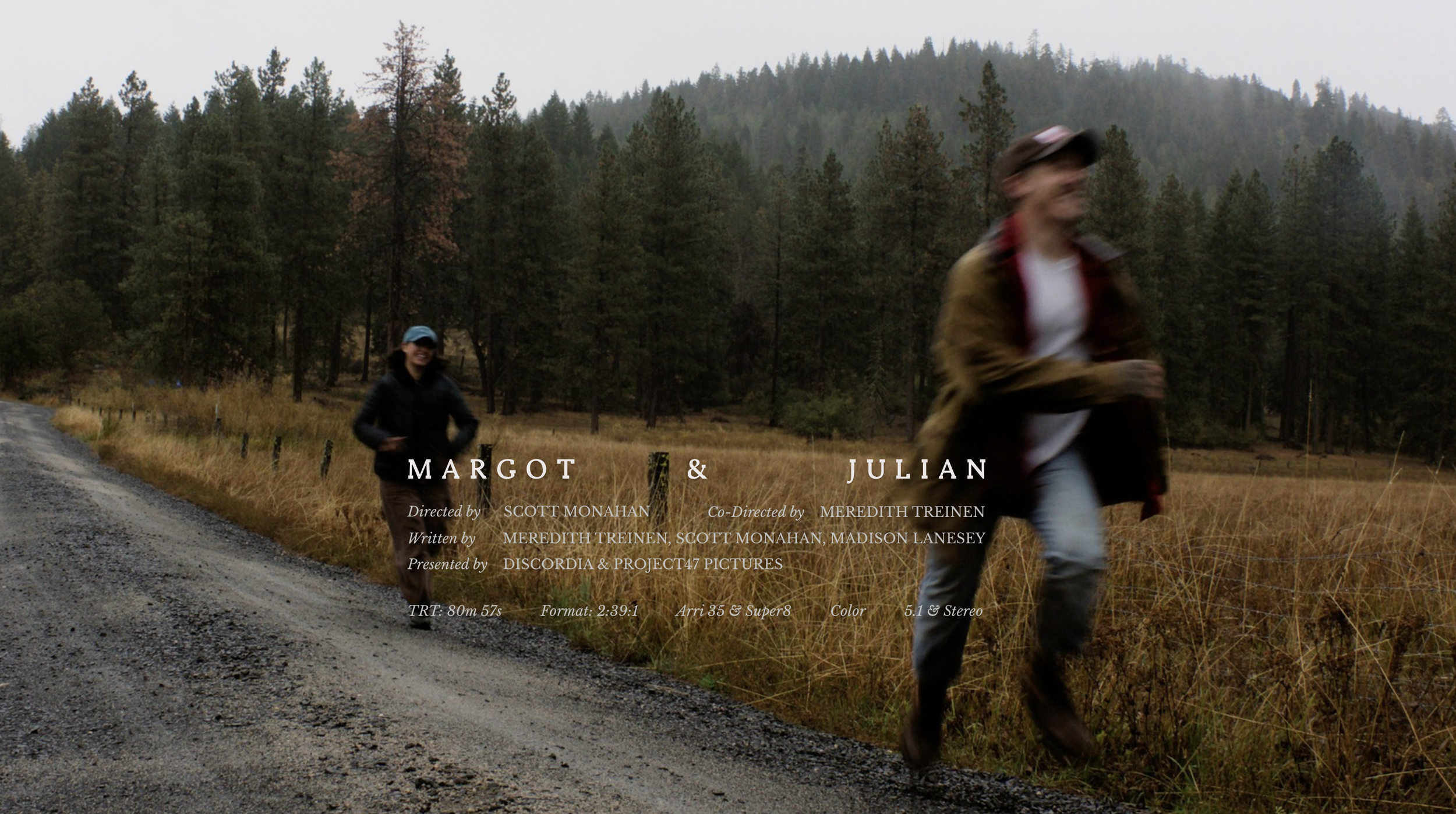
Margot & Julian was a finalist for our Spring 2026 Grant Program, a feature project with a heart-centered story and scrappy, experienced filmmaking team behind it. Co-Writer and director Scott Monahan shared a bit of his process with us just as the project was completed and preparing for festival submissions.
How did you fund the project?
[SM] I wanted to try something different with fundraising this time. The film is deeply personal and sensitive, and early on we were still discovering what it was, so a public campaign didn’t feel right, even though I’ve successfully crowdfunded before.
Instead, I reached out directly, aiming to raise $5,000 from 10 people or $2,500 from 20. I was clear there was no ROI, no perks. Just, if you connected with my last film and wanted to support another, it would mean a lot. In three months, I raised $29,340 from 12 people! A month before shooting, I used a 0% APR balance transfer offer to cover a $10,000 gap, which I’ve since fully paid off.
Now I’m focused on raising the final $20,000 for post-production, with the goal of finishing the film by August of 2026!
Did you have funding in place before writing, or get funding together after you wrote the script?
[SM] I was fundraising while we were working on the script. Once I found the location, I booked it for the entire month of October to take advantage of a 45% discount rather than just the two weeks we were shooting. I set the dates, assembled the team, and committed to making the film with whatever we had raised by then. It required real trust in the process.
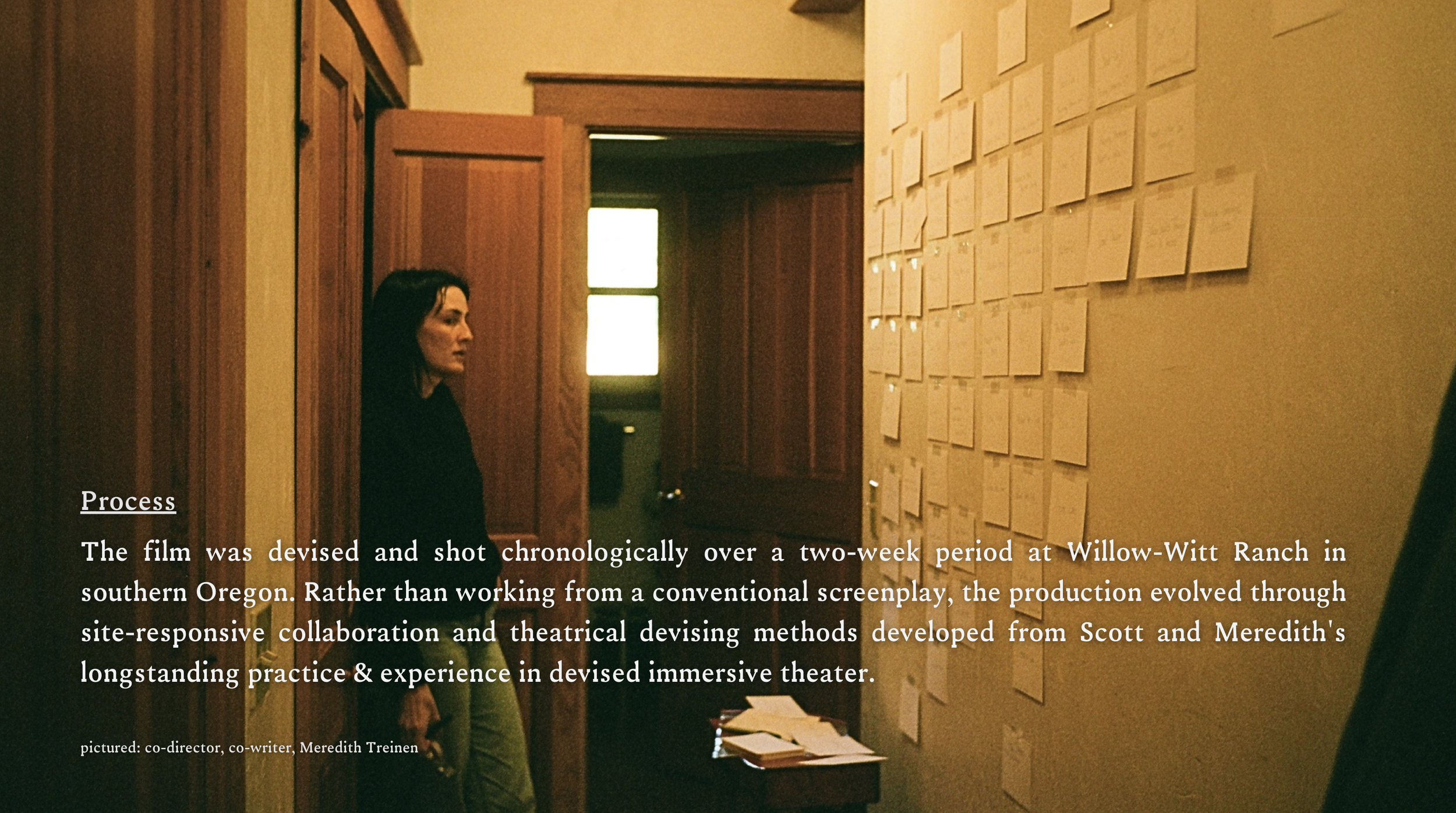
With this being my second feature, I wanted to explore a more experimental approach, pulling from my background in collaboratively devised, site-responsive theater, my decade of working creatively with Meredith Treinen (Co-Director, Writer, Producer), and the creative chemistry I found with Madison Lanesey (Margot, Writer, Producer) on a previous short. We held a devising weekend in August at the location, using movement, vocal, and writing exercises to build the film. By the time we started shooting in October, we had a strong outline and partial script, leaving space for the work to fully come alive during production.
What are some of the pros about funding this way? The cons?
[SM] GoFundMe is incredible because when someone contributes, the money hits your account within the week. There’s no goal to hit, no review board, it’s just a direct way for people to support you. I’ve found you really only get one click from people. If they have to create an account, they might not do it in the moment and then it’s gone. Everyone already knows GoFundMe, and you can do it from your phone. Honestly, I haven’t found any real downsides.
With traditional crowdfunding, there’s often an emphasis on rewards. Personally, I’ve never given to a project for a t-shirt or a download. I just want to support the film and move on. While rewards can build community, they also take a lot of time and energy to create and fulfill, and I’d rather put that energy into the film itself.
What is your long-term vision for the project?
[SM] I’m finishing Margot & Julian at the same time of year I finished my first feature very intentionally. I know the festival timelines, I’ve built relationships, and I understand how to navigate that circuit now. My plan is to follow what worked from my last run, while being more precise about what didn’t.
Festivals are the heart of it for me. Meeting other filmmakers, supporting their work, traveling, doing Q&As, and actually sharing the film with audiences, that’s the experience I care most about.
Distribution is a different landscape right now. My last distributor went bankrupt, and the traditional model feels increasingly unstable. But there are more tools than ever to take control of your own release. I’m open to the right partnership if it presents itself, but if it doesn’t, I’m fully prepared to self-produce an independent theatrical run and then bring the film directly to audiences myself.
Did you learn anything when it comes to funding and budgeting that you will do differently on your next project?
[SM] I’m constantly refining how I work. Small crews, natural light, keeping the story and characters at the center, minimizing distractions. I’m open to scaling up, but only in a way that feels natural. My first feature was $20K for production over 5 days of shooting, $20K for post, and $20K for distribution. This one was $45K for production over 10 days, with about $20K for post and likely the same for distribution.
In a dream scenario, I’d make the film for around $60K all-in, and then bring someone in at the end to spend real money on marketing. That’s the missing piece. Not outdated tactics or merch, but smart, intentional marketing. That’s what gives films like this a real shot at reaching the audience they deserve. I think everyone would love for someone to come in and just take over for you, let you rest your tired legs and they do the work. But, in reality this often doesn't happen, so take breaks when you can and gear up for each stage with as much energy as the one before it!
Were there any areas where you were able to call in favors/save money? What were those areas?
[SM] I find this mostly shows up with gear. If a friend, crew member, or producer has a strong relationship with a rental house, you can save a significant amount there. I try to pay people as much as I possibly can within my budget. I’m very transparent with each team member about the budget, I don’t pay myself, and I make sure the team is taken care of, well fed, reasonable 8–10 hour days, and treated with respect.
I also keep the crew extremely lean. Outside of directing, writing, and actors, it’s just a DP, AC, production sound, and a producer. We use mostly natural light, and we handle props, set design, and wardrobe ourselves.
Did you get any budget or expense surprises that you weren’t expecting?
[SM] We got access to an ARRI 35 for practically nothing, which was incredible, but the file sizes are massive. Not knowing exactly how much we’d be shooting each day, I wanted to play it safe, so I bought three 20TB hard drives to back everything up twice. That ended up costing $1,600. A week later I saw the charge, panicked, called fraud, and said, “Why would I spend $1,600 on Amazon?” Only to realize it was the drives!
One thing I never skimp on is food. If we have a long day and go out to dinner, there’s no limit. I hand over my card and let the crew order whatever they want. Feeding people well, sharing meals, making memories, that’s a debt I’ll carry proudly. How often do you get to pay for all your friends’ dinners for two weeks? It feels like winning the lottery. And in a way, I did. I got to make a movie with my friends, and nothing beats that.
Any fun anecdotes you'd like to share?
[SM] The house is completely off-grid powered by solar and generators and heated by a wood burning stove! We all learned how to build and maintain fires and it became a central piece of our production, chopping wood, eating s'mores, cooking grilled cheese on the stovetop, telling stories, and just warming up around it. It was truly one of the most heartwarming creative projects of my entire life.
What do you think people will be interested in knowing that I haven't asked?
[SM] We all know the old adage that you shouldn’t talk about sex, money, or politics. But I think there’s a fourth, largely unspoken rule, at least in America and many Western cultures: don’t talk about death.
And yet, one of the most surprising things I’ve discovered through this project is how much people actually want to talk about it. Whenever I tell someone what I’m working on, the conversation often turns into stories about people they’ve lost, experiences they’ve had with death, or questions they’ve carried with them for years. In that sense, simply talking about death seems to create an opening, an invitation for people to share, remember, grieve, and reflect on something we rarely give ourselves permission to discuss, especially with a stranger.
I don't think it's morbid to think about death. Every single person in history has died. I think by exploring our thoughts, fears, and expectations around mortality, it helps us to better understand and appreciate the beauty and the gift that is to be alive.
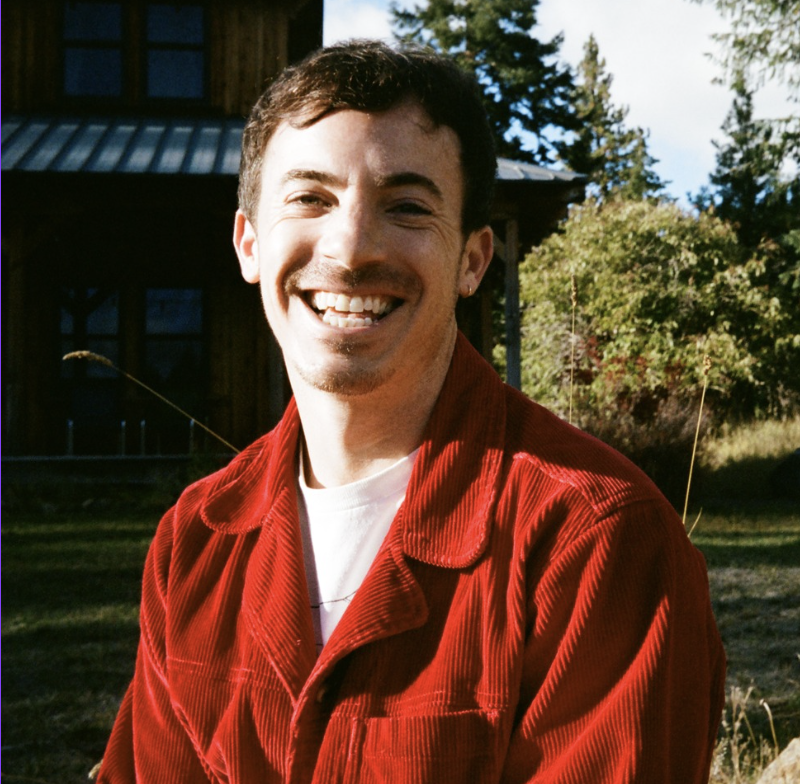
Co-writer/Director Scott Monahan
About Scott Monahan
Scott Monahan is an international award-winning director and producer whose work is defined by a raw, independent approach to storytelling and a commitment to bold, personal filmmaking. He studied theater at Shenandoah Conservatory before relocating to Los Angeles, where he became deeply involved in the immersive theater scene. Monahan served as Artistic Director of Play Collaborative Arts and is a company member of Ceaseless Fun, two of Los Angeles’ leading site-responsive theater collectives. His work across these mediums reflects a dedication to experimentation, immediacy, and direct audience engagement.
He made his feature directorial debut with Anchorage, which he also produced and starred in. The film received critical acclaim on the international festival circuit, winning eleven awards including the German Independence Award for Best Feature Film at the Oldenburg International Film Festival, the Audience Award for Best Feature at the Mammoth Film Festival, and Best Feature Film at the Jim Thorpe Independent Film Festival. He is recognized within the independent film community for his openness and transparency, Monahan actively shares his creative process and production approach, contributing to a broader culture of resourcefulness and collaboration among emerging filmmakers.
Scott Monahan Instagram: @chipsahoyjunkie
Margot & Julian | Instagram: @margotandjulian